
You have no items in your shopping cart.


Start a School Newspaper: Guide & Checklists
8/4/2026 1:32 PM By Sofia Schmidt
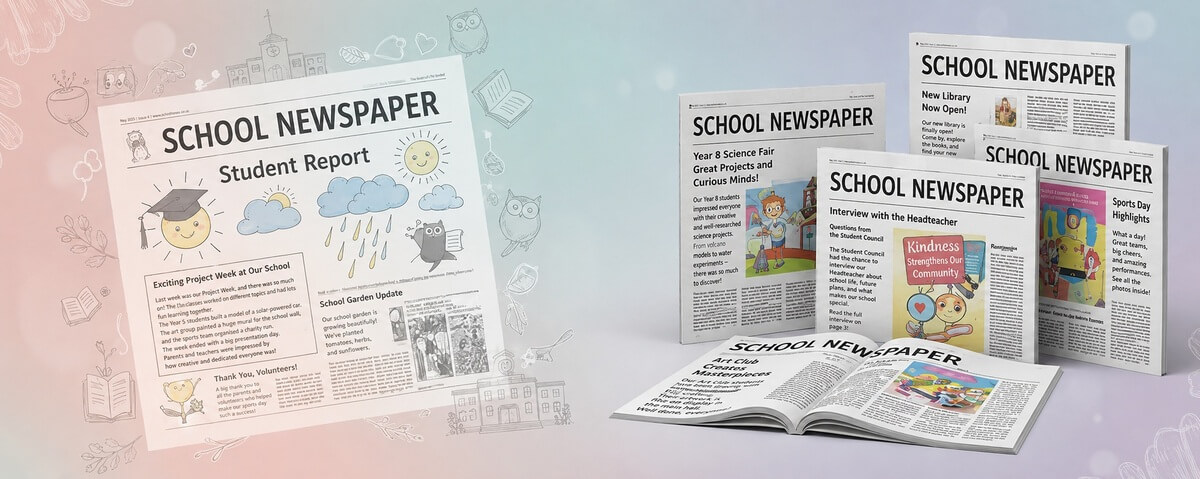
Starting your own school newspaper is an exciting project that captures the voices of your school community and gives students a platform to share their ideas. In this guide, we show you step by step how to start a school newspaper, build an editorial team, assign the right roles and choose interesting topics.
Get inspired by our checklists and expert tips to launch your unique school newspaper quickly and easily. Whether you are setting up a school club, planning a project week or organising regular editorial meetings, a well-structured plan helps you stay organised and creates the foundation for a successful school newspaper.
Explore our guides on how to start a school newspaper, or browse our ready-to-use templates to quickly create your school newspaper.
Click on the chapter you are interested in:
Why start your own school newspaper?
Starting a school newspaper: The first steps towards your own editorial team
Assigning roles in your school newspaper editorial team
effectively
Finding topics & creating an editorial plan
for your school newspaper
Timeline for your school newspaper: From the first idea to printing
Starting your school newspaper with the right layout software
Funding your school newspaper
– adverts & sponsors
Checklist for professional printing
of your school newspaper
Starting your own school newspaper – summary
Why start your own school newspaper?
There are many reasons why starting a school newspaper is worthwhile: It gives students a platform, highlights topics from everyday school life and turns ideas into a real community project. Along the way, you learn much more than just writing, researching and designing – you also develop important skills in teamwork, responsibility and organisation.
For teachers, a school newspaper is a fantastic way to nurture students' talents while bringing media literacy into the classroom. The school benefits too, as a well-produced newspaper strengthens the school community and creates a genuine sense of togetherness. In short: A school newspaper brings creativity, project spirit and teamwork to paper and turns students' commitment into something they can see and hold in their hands.
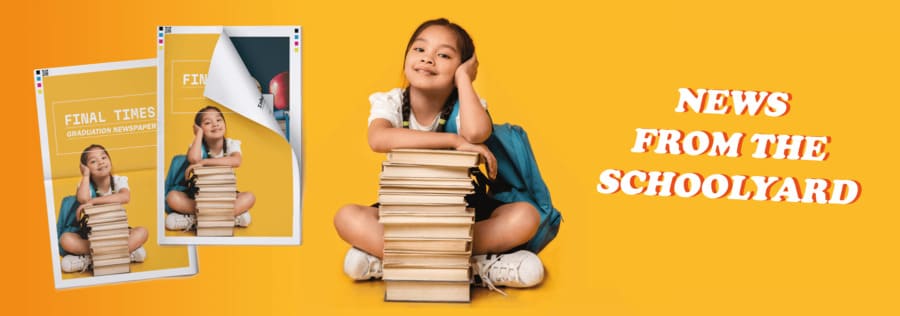
Starting a school newspaper: The first steps towards your own editorial team

- ✅ Define the purpose of your school newspaper: What do you want to achieve and who exactly are you writing for?
- ✅ Assign clear roles: Who will write, organise, take photos or create the layouts?
- ✅ Decide on your editorial structure: Will it be a school club, project group or independent student editorial team?
- ✅ Involve a teacher or supervisor: Who will support and guide the project?
- ✅ Discuss the project with the school management: What is allowed and what support is available?
- ✅ Decide on your publication schedule: How many issues do you want to publish and how often?
- ✅ Create a timeline for the launch: First meeting, topic planning, deadlines and printing dates
Once these basic rules have been agreed, the real work on your school newspaper can begin. The next important step is the allocation of specific roles. Who is responsible for which task and when?
How to assign roles in your school newspaper editorial team
A successful school newspaper works like a small machine: Every part has its own purpose. Together, these roles create a finished newspaper that works smoothly from the front page to the final credits. Clear role distribution creates structure from the start. When every team member knows their responsibilities, nothing stands in the way of producing a great school newspaper.
| Role | Responsibilities |
|---|---|
| Editor-in-Chief | Coordinates the whole publication from start to finish, plans each issue, coordinates the team, and makes final decisions on content, structure, and approval. |
| Editor | Writes articles, researches stories, and develops engaging content ideas together with the editorial team. |
| Reporter | Covers school life, gathers opinions, and reports on events, projects, trips, and activities. |
| Interviewer | Conducts interviews with teachers, students, alumni, or guests and turns their answers into engaging articles. |
| Photographer | Takes photos of school events, portraits, and everyday moments to create strong visual content. |
| Designer / Layout Editor | Designs page layouts, arranges text and images, and ensures the school newspaper looks modern and easy to read. |
| Copy Editor | Checks spelling, grammar, style, and clarity to make sure every article is polished before publication. |
| Proofreader | Carries out the final quality check by spotting typos, incorrect names, duplicate content, and missing photo captions. |
| Social Media Manager | Promotes new issues, shares behind-the-scenes insights, and raises awareness of articles, polls, and school activities. |
| Advertising & Sponsorship Coordinator | Finds advertisers and sponsors and helps generate income through advertising and newspaper sales. |
| Print & Production Coordinator | Checks the final PDF, ensures everything is complete and in the correct order, reviews the print file, and manages the final step before ordering. |
Finding topics & creating an editorial plan for your school newspaper

- ✅ Interview with the headteacher: What plans, changes or challenges are currently shaping the school?
- ✅ Student survey: What frustrates students most about school life, and what would they like to change?
- ✅ Teacher profile: Who is the person behind the lessons?
- ✅ Behind the scenes: Introduce the caretaker, school office, canteen team or student support services.
- ✅ Report from a school event, sports day or project week: Capture the atmosphere, opinions and memorable moments.
- ✅ School trip or exchange report: Share experiences, funny moments and highlights.
- ✅ Opinion piece: Explore a controversial topic from school life in a fair and engaging way.
To turn these ideas into a finished newspaper, you need an editorial plan. It acts as your shared roadmap. Instead of collecting articles in a rush shortly before printing, you decide early which topics will appear in your issue and when each task needs to be completed. This creates structure and prevents good ideas from getting lost. Especially in larger teams, a clear plan ensures everyone knows what needs to be done next and where there are still gaps.
- ✅ Assign a responsible person to each article, so important tasks are completed on time.
- ✅ Give every topic a clear status: idea, in progress, being edited or completed.
- ✅ Plan page numbers and sections early, so the newspaper feels balanced and well structured.
- ✅ Set clear deadlines for research, writing, images, proofreading and layout.
- ✅ Include time buffers in case interviews fall through or content takes longer than expected.
- ✅ Review your plan regularly during editorial meetings, so you can adjust quickly if needed.
Timeline for your school newspaper: From the first idea to printing
Once the editorial roles are assigned, the first topics are chosen and your editorial organisation is in place, you need one thing above all: a clear timeline for your school newspaper. It helps you stay organised, plan tasks efficiently and publish your first issue without unnecessary stress.
| Stage | Timeline | Key Tasks | Goal |
|---|---|---|---|
| Idea & Getting Started | Week 1 | Define the purpose of your newspaper, recruit your first team members, involve the headteacher or supervising teacher, and decide on the basic format. | A clear foundation for the project is in place. |
| Build the Editorial Team | Weeks 1–2 | Assign roles, define responsibilities, agree on communication methods, and hold your first editorial meeting. | Everyone knows their role and responsibilities. |
| Plan Your Content | Week 2 | Brainstorm story ideas, choose articles, decide on sections, and start planning interviews or surveys. | A balanced mix of content has been planned for the first issue. |
| Create an Editorial Plan | Weeks 2–3 | Set deadlines, assign responsibility for each article, plan the page count, and create a content tracking overview. | The editorial plan keeps the project on track. |
| Research & Writing | Weeks 3–5 | Write articles, conduct interviews, collect quotes, and take photographs. | All content is complete. |
| Editing & Proofreading | Weeks 5–6 | Check language, verify names and facts, improve headlines, and obtain final approvals. | Every article is ready for print. |
| Layout & Design | Weeks 6–7 | Design the page layouts, place images, create the front page, and finalise the overall newspaper layout. | Your newspaper has a professional look and feel. |
| Check Print Files | Week 7 | Export the PDF or finalise your online design, check the page order, review all images, and complete your final pre-print checklist. | The issue is fully prepared for printing. |
| Printing & Distribution | Week 8 | Place your order, allow time for delivery, announce the new issue at school, and then distribute or sell copies. | Your planning becomes a finished printed school newspaper. |
Start a school newspaper with the right layout software
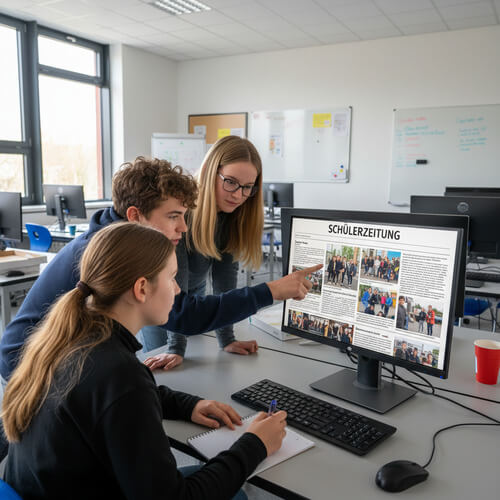
For advanced users
InDesign
Ideal if you want to create a professional school newspaper layout and have full control over page structure, typography and image placement.
- ✅ Maximum creative freedom for more extensive school newspapers
- ✅ Precise work with grids and paragraph styles
- ✅ Ideal for teams that regularly plan new editions
- ✅ Especially suitable for high-quality print PDFs
Quick start
Canva
Perfect if you want to get started without much previous experience and create your school newspaper easily and intuitively.
- ✅ Easy to use and quick to understand
- ✅ Many templates for a simple start
- ✅ Great for school projects with little layout experience
- ✅ Excellent teamwork for ideas, drafts and approvals
Particularly simple
Smartpaper24 Online Designer
The best choice to create your school newspaper online and print it in small quantities.
- ✅ No additional software required
- ✅ Direct route from layout to print
- ✅ Practical for beginners, school clubs and spontaneous projects
- ✅ Ready-made templates for classes, primary schools and graduation events
Funding a school newspaper – adverts & sponsors
Between exciting articles and eye-catching photos, one practical question often comes up: How can you fund your school newspaper with adverts and sponsors?. With good planning, this is possible even with a small budget. A smart combination of adverts, sponsors and sales at school is often enough to cover printing costs and smaller expenses. Local businesses, parent associations or bakeries near the school are often open to supporting school newspapers because they encourage young people’s media projects while also gaining visibility as advertising partners. These tips will help you consider funding and sponsorship from the very beginning:
Adverts from local businesses
- ✅ Contact bakeries, bookshops, tutoring centres, driving schools or sports clubs in your local area
- ✅ Offer fixed advert formats, for example 1/4 page, 1/2 page or a full page
- ✅ Prepare a short information sheet with prices, print run, target audience and publication date
- ✅ Highlight the benefits: visibility among students, teachers and parents
Sponsors for the whole project
- ✅ Find supporters such as parent associations, family businesses or regional companies
- ✅ Name sponsors clearly, for example in the legal notice, on a supporter page or on the back page
- ✅ Present the project as a way to promote media skills and school involvement
- ✅ Create small sponsorship packages to make it easier for supporters to get involved
Sales directly at school
- ✅ Organise sales during breaks at a dedicated stand
- ✅ Offer editions at school events, parents’ evenings or project days
- ✅ Collect pre-orders from classes to plan the print run more effectively
- ✅ Set a fair selling price, for example £1 to £3 depending on the size
Practical mix for getting started: A combination of a few small adverts, one or two sponsors and sales at school often works best. This means your funding does not depend on a single source of income.
- ✅ Compare income and printing costs in a simple overview
- ✅ Decide early how many advert spaces you want to offer
- ✅ Start small and realistically instead of making your first edition too commercial
Sample text to attract sponsors for your school newspaper
Dear Sir or Madam,
We are the editorial team of [School name] and are currently working on our school newspaper [School newspaper name]. With our newspaper, we want to highlight exciting topics from school life, introduce student projects and give young people their own voice. To help us print our next issue, we are looking for supporters from our local community.
We would therefore like to ask whether you would consider supporting our project through an advert or sponsorship. The issue will be published on [Publication date] with a print run of [Number of copies] copies.
We would be happy to provide further information about advert formats, prices and placement options. We look forward to hearing from you at [Email address / phone number].
Kind regards
[Contact person / editorial team]
[Class / club / school]
School Newspaper Printing Checklist
Our creative school newspaper templates make it quick and easy to start a school newspaper. Every template comes ready for print, with embedded fonts, the correct print area and professional layouts. If you prefer to create your newspaper in different software and upload your own file, use this checklist to prepare your artwork for professional printing.
Check the page count: Does your newspaper have between 4 and 60 pages, and is the total number of pages divisible by 4?
Check the format: Have you set your document to 280 × 400 mm with a printable area of 251 × 370 mm?
Export your PDF correctly: Does your file contain single pages in order, not printer spreads?
Check the page order: Are all pages in the correct sequence, from the front cover to the final page?
Use the correct colour mode: Are all images and graphics saved in CMYK?
Use the correct colour profile: Does your file use the FOGRA39 colour profile? Download it here: Download FOGRA39 free
Check image quality: Do all images have a minimum resolution of 140 dpi for sharp, high-quality printing?
Check fonts and content: Are all fonts embedded, and have you checked that every article is complete and easy to read?
Remove placeholders: Have you deleted all sample text, placeholder images, notes and comments before printing?
Test your final PDF: Does your print-ready PDF open without errors and look exactly as planned, even after checking it on a second device?
Carry out a final review: Have you checked the headlines, page numbers, names, images and front cover before sending your newspaper to print?
How to Start a School Newspaper – Summary
- Start a school newspaper: Build your team, define your goals and involve a teacher from the beginning.
- Create your editorial team: Typical roles include editor-in-chief, interviewer, designer and proofreader.
- Find great stories: Draw inspiration from school life, projects, surveys and opinion pieces.
- Create an editorial plan: Set responsibilities, page counts, deadlines and approval stages.
- Design your school newspaper: Use the Smartpaper24 online editor or your preferred design software.
- Secure funding: Advertising, sponsorship and newspaper sales often cover a large share of the costs.
- Prepare for print: Double-check the format, page order and image resolution before placing your order.
***This blog article was created with partial assistance from AI.
Posted in News
By